HaloVault native client
The problem: Collectors need a camera-first capture and review workflow that handles uncertain recognition, protects sessions, and makes the next action clear.
My engineering contribution: Swift and SwiftUI application flows in Xcode, capture and quality-review interfaces, Keychain session storage, Sign in with Apple nonce handling, scoped offline storage, and a remote API transport boundary.
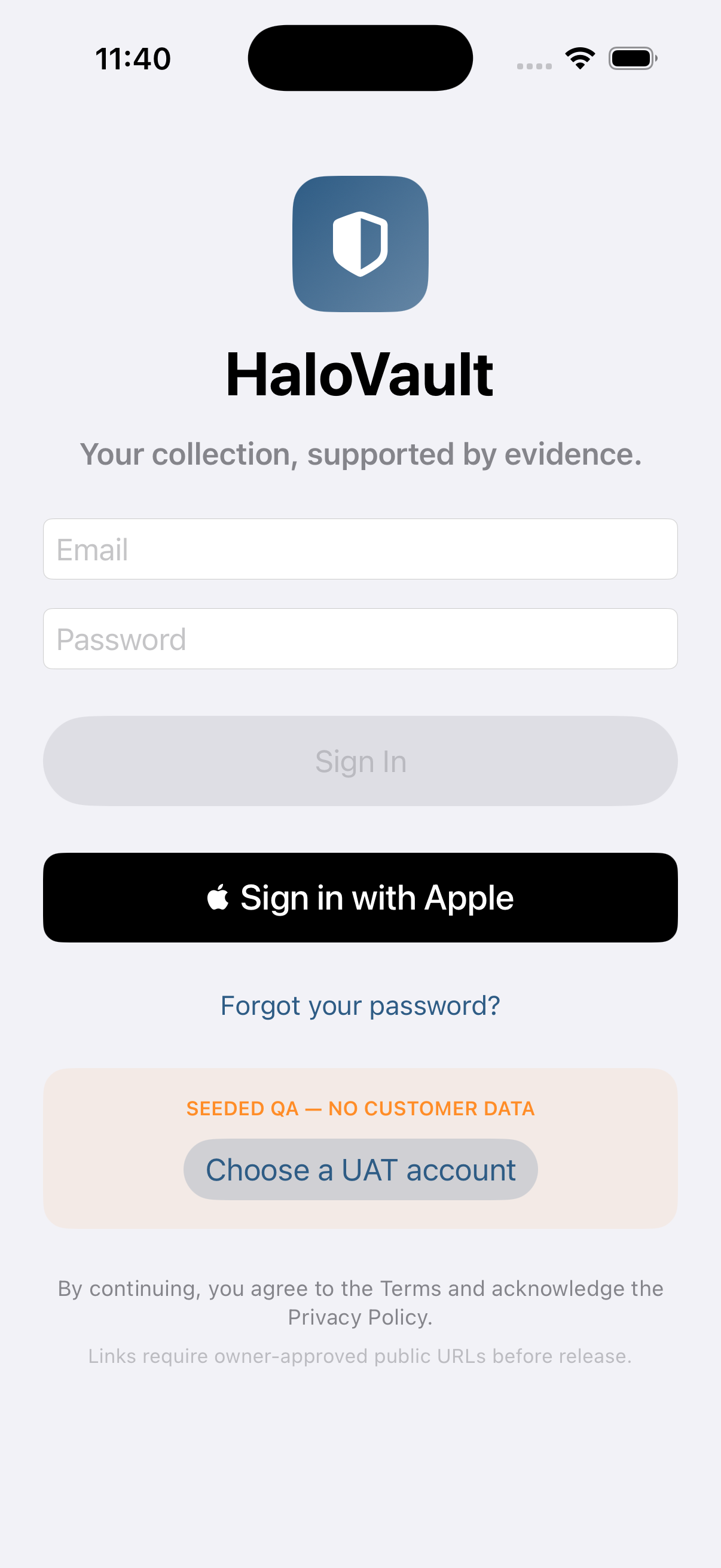
- Capture and review · SwiftUI clientFront/back capture, image quality warnings, candidate alternatives, and required user confirmation.
- Session and transport · native servicesSecure session handling, request construction, cancellation, and explicit failure states.
- API boundary · Python backend contractVersioned operations define uploads, analysis jobs, retrieval, and confirmation; deployed compatibility needs separate certification.
- Authoritative state · backend systemsThe backend owns durable records and authorization; UI or simulator success does not certify it.
Testing and release engineering
The reviewed August 4, 2026 evidence record reports 47 unit tests and 7 UI tests passing, along with unsigned builds and archive work. The coverage includes session lifecycle, offline state, request construction, capture workflows, and selected accessibility settings.
What that evidence does not establish: physical-device QA, signed distribution, TestFlight acceptance, complete remote-operation compatibility, backend tenant isolation, or commercial release. Those remain separate gates in the reviewed record.
- Swift
- SwiftUI
- Xcode
- Camera workflows
- Keychain
- REST API transport
- Unit / UI tests
Full-stack connection
Camera input becomes a bounded upload or analysis request. Recognition returns candidates and supporting evidence. The native interface exposes uncertainty and asks the user to confirm; backend services own authorization, persistence, and the final record. That ownership boundary is central to HaloVault and ShopOS workflow design.